
Getting the correct trekking pole length is one of the most important—and most commonly overlooked—parts of using hiking poles. Poles that are too long or too short don’t always feel wrong right away, but over longer hikes they can reduce efficiency, strain your joints, and make uneven terrain harder to manage.
This guide explains how high trekking poles should be, how pole length changes with terrain, and why length alone doesn’t tell the whole story.
Why Trekking Pole Length Matters
Trekking poles work best when your arms can move naturally and share some of the load with your legs. When pole length is set correctly, most hikers notice that they can:
- Reduce impact on knees and hips
- Maintain better balance and rhythm
- Walk more smoothly without forcing posture or stride
When pole length is off, the problems usually show up gradually—stiff arms, awkward pole plants, or fatigue that builds faster than expected, especially on longer hikes or steeper trails.
How High Should Trekking Poles Be? (The Base Length Rule)
How to find your base trekking pole length:
- Stand upright on flat ground
- Place the pole tip on the ground next to your foot
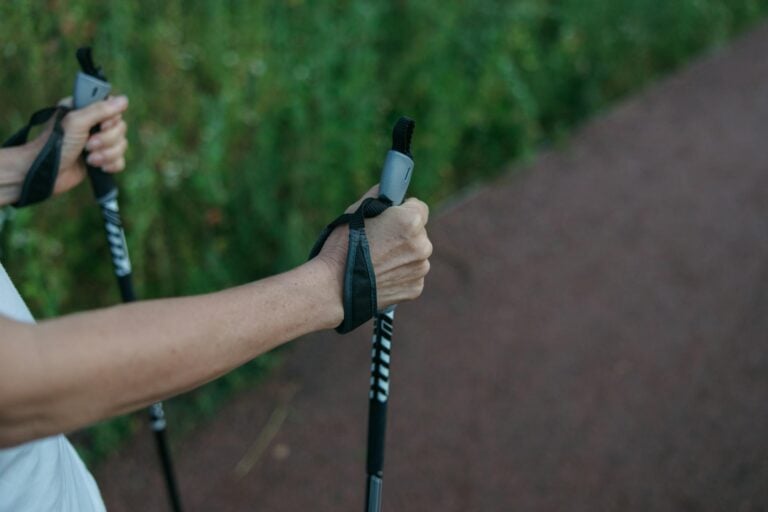
- Hold the grip naturally
- Your elbow should form a 90-degree angle
This position allows your arms to transfer weight efficiently without locking your shoulders or wrists. It should feel similar to how your arm naturally rests when pushing a door open or holding a shopping cart handle.
Pole height is only one part of the equation—understanding how to use trekking poles properly matters just as much as getting the length right.
Adjustable vs. Fixed-Length Trekking Poles
Most modern trekking poles are adjustable, which makes them a better fit for hiking that includes changing terrain.
- Adjustable poles let you shorten or lengthen quickly for uphill and downhill sections
- Fixed-length poles are lighter but require precise sizing and offer less flexibility
For beginners and general hiking, adjustable poles are usually the better option. Trails rarely stay flat or consistent for long, and small length changes can make a noticeable difference in comfort.
Flat Ground
On maintained trails, fire roads, or packed dirt paths:
- Use your base length
- Keep elbows near a 90-degree bend
- Let pole tips land close to your feet
Uphill Hiking
On steady climbs or switchbacks:
- Shorten the poles slightly
- This prevents your arms from lifting too high
- Helps maintain a strong, forward-leaning posture
Downhill Hiking
On long descents with loose dirt, gravel, or hard-packed trail:
- Lengthen the poles slightly
- Allows poles to absorb more impact
- Improves balance and reduces knee strain
These adjustments work best when combined with proper trekking pole technique, not just accurate measurements.
Common Pole Length Mistakes
Many hikers struggle with pole length because of a few recurring habits:
- Keeping poles the same length regardless of terrain
- Setting poles too long to try to “reach farther”
- Locking elbows instead of keeping a relaxed bend
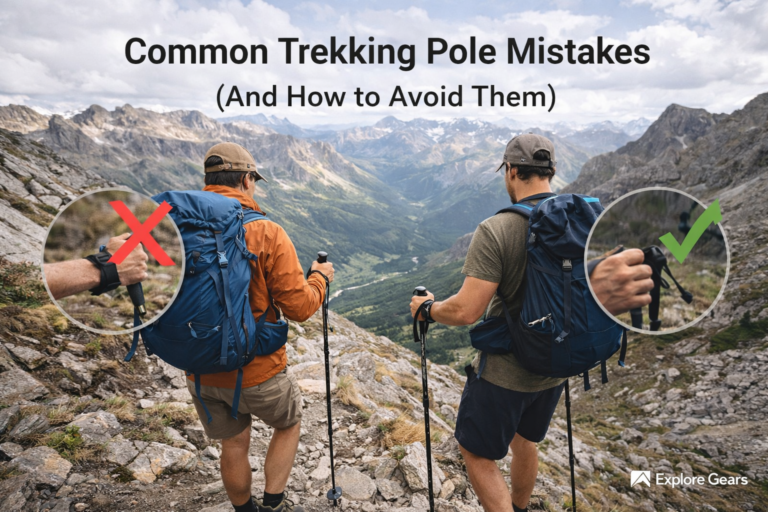
- Ignoring wrist strap support and gripping too tightly
Small corrections in pole height and arm position often lead to noticeable improvements in comfort and control.
Does Trekking Pole Length Affect Knee Pain?
Yes—especially on downhill sections.
Poles that are too short on descents don’t absorb enough impact, forcing your knees to take more load. Poles that are too long can pull your upper body backward, disrupting balance and timing.
When set correctly, trekking poles act as a controlled support system. They help manage impact and stability—but they don’t replace careful footing or pacing.
Final Thoughts: Length Is a Foundation, Not a Shortcut
Correct trekking pole length creates a solid foundation for efficient movement, but it isn’t a shortcut to good technique. Pole height, wrist strap use, planting angle, and rhythm all work together.
Once your poles are set correctly, adapting them to different terrain feels more natural—and hiking becomes more controlled, comfortable, and enjoyable over long distances.