
- Why Ski Poles Matter More Than Beginners Think
- The Most Common Beginner Mistakes with Ski Poles
- Length First, Material Second
- How to Find Your Correct Ski Pole Length
- Carbon vs Aluminum: What Actually Changes Mechanically
- Impact Tolerance, Vibration, and Failure Modes
- Durability in Real Terrain: Trees, Bumps, and Hardpack
- Rental vs Buying Logic for Beginners
- What Defines a “Good Beginner Aluminum Pole”
- When Carbon Makes Sense for Beginners
- How Beginner Needs Change After 1–2 Seasons
- A Neutral Checklist for Choosing Your First Ski Pole
- Conclusion: Tools and Judgment Beat Marketing Claims
Ski poles are often treated as accessories. Skis get all the attention. Boots are considered critical. Helmets and goggles are obvious safety gear. Poles are frequently chosen last, sometimes based on color, sometimes based on price, sometimes simply because “they came with the rental.”
For beginners, this is a mistake.
Not because ski poles are complicated, but because they quietly influence almost every part of how you move on snow: balance, rhythm, timing, confidence, and even fatigue. A poorly chosen pole won’t stop you from skiing, but it will subtly make everything harder. A well-chosen one won’t magically make you ski better, but it will make progress feel smoother and more predictable.
This guide exists for one purpose:
to help beginners understand ski poles as functional equipment, not marketing objects.
No brand pushing.
No “best product” lists.
No shortcuts.
Just real mechanics, real trade-offs, and real decision logic.
By the end, you should be able to answer three questions clearly:
- What length of ski pole actually fits your body and stance?
- What material fits your terrain, skiing style, and tolerance for impact?
- Whether buying even makes sense yet compared to renting.
And you should be able to answer them without relying on advertising claims.
Why Ski Poles Matter More Than Beginners Think
A ski pole does four fundamental jobs:
- Balance reference – It gives your brain a stable point in space.
- Timing cue – Pole plants organize turn rhythm.
- Stability aid – In rough terrain, poles widen your base of support.
- Load transfer – They shift small portions of body weight to the upper body.
Beginners often use poles less actively than advanced skiers, but that does not make them less important. In fact, poles matter more when:
- You are learning balance
- Your turns are inconsistent
- Terrain feels unpredictable
- Confidence is fragile
A wrong pole length can throw off posture.
A wrong material can transmit vibration or fail under impact.
A wrong grip or basket can reduce stability in soft snow.
None of these will be obvious on day one.
But across 10–20 ski days, the difference becomes measurable.
The Most Common Beginner Mistakes with Ski Poles
Most beginners make one or more of these choices:
- Choosing poles based only on height charts without checking stance
- Choosing the cheapest option because “it’s just a pole”
- Choosing carbon because it sounds “premium”
- Choosing aluminum because it sounds “indestructible”
- Using rental poles for years without re-evaluating
None of these are irrational. They are just incomplete.
A better approach is to understand what poles actually trade:
| Property | What It Means |
|---|---|
| Weight | Swing feel and fatigue |
| Impact tolerance | Resistance to bending or breaking |
| Vibration | Comfort on hard snow |
| Flex | Feedback vs forgiveness |
| Durability | How poles age over time |
| Cost | Replacement risk vs performance |
Ski poles are mechanical tools.
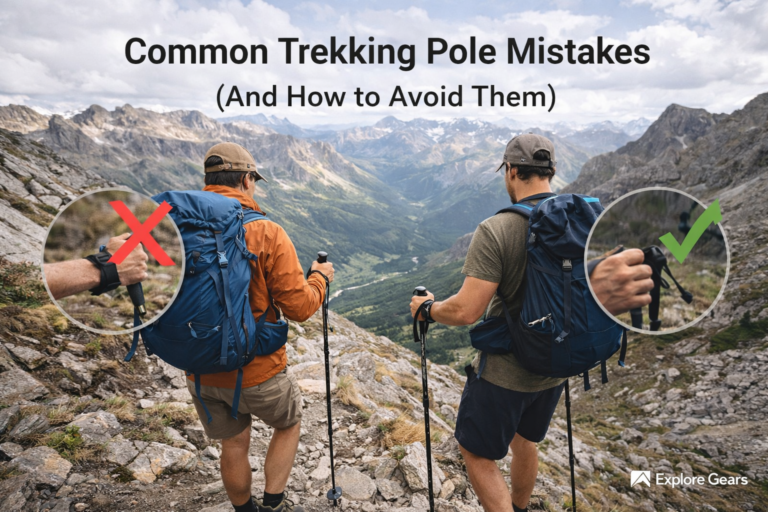
You choose them like you would choose a hiking trekking pole, a bike handlebar, or a climbing carabiner: based on use case, not image.
Length First, Material Second
This is the single most important rule for beginners:
A correctly sized aluminum pole is better than an incorrectly sized carbon pole.
Length defines posture.Material defines behavior.
If your length is wrong:
- Your wrist angle is off
- Your shoulders lift or drop unnaturally
- Your timing becomes inconsistent
- Your balance reference point is distorted
Material differences are subtle compared to length errors.
That is why pole selection should always start with sizing, not construction.
How to Size Ski Poles for Beginners
Choosing the right ski pole length matters more than most beginners think.
A good fit helps you stay balanced, keep your stance natural, and avoid posture mistakes.
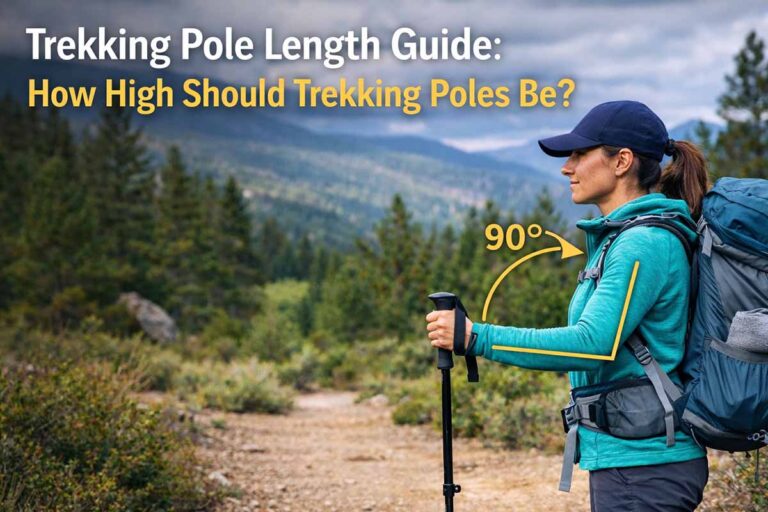
1. Ski Pole Sizing Tips: The 90-Degree Elbow Method
The traditional method:
- Flip the pole upside down
- Grab under the basket
- Your elbow should form roughly a 90° angle
This method works, but only if:
- You wear ski boots
- You stand on a flat surface
- You use your normal skiing posture
2. A More Accurate Way: Calculate Ski Pole Length by Height
The more accurate way is to calculate ski pole length from your height and stance preference.
That’s why we built the Ski Pole Length Calculator.
It gives you:
- Length in centimeters
- Length in inches
- Rounded size guidance
- Beginner vs performance stance variations
It removes guesswork and helps prevent posture errors—especially for first-time skiers.
At this stage of selection: Length is not a preference. It is geometry.
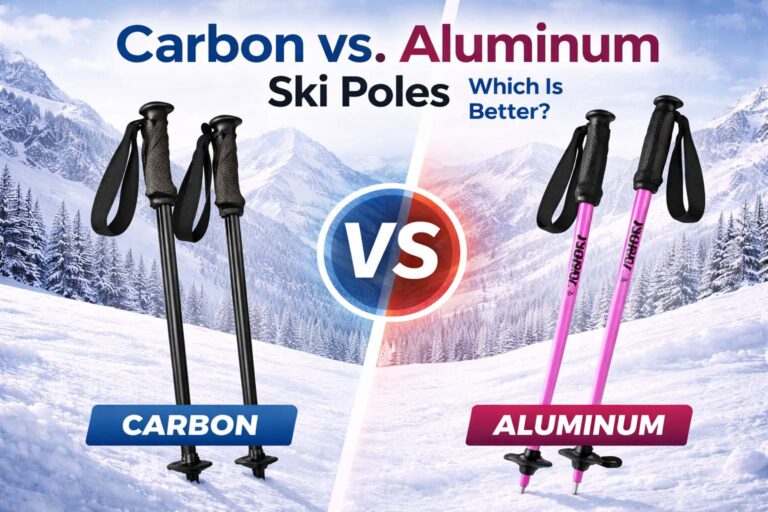
Carbon vs Aluminum: What Actually Changes Mechanically
When people talk about ski pole materials, the discussion often sounds emotional:
“Carbon feels premium.”
“Aluminum is bombproof.”
“Carbon is for pros.”
“Aluminum is for rentals.”
These statements contain partial truth, but they miss the mechanical reality.
Carbon and aluminum behave differently because they fail differently, flex differently, and transmit force differently.
Understanding this is more important than memorizing “which is better.”
1. How Aluminum Poles Behave
Most aluminum ski poles are made from high-strength alloys such as 6061 or 7075.
The difference between them is yield strength, not marketing language.
What aluminum does well:
- Absorbs impacts by bending
- Shows visible deformation before failure
- Handles sideways loads better
- Survives chairlift mishaps, rocks, and tree strikes
When aluminum fails, it usually does so slowly:
- It bends
- It becomes misaligned
- It still functions until replaced
For beginners, this is a very forgiving failure mode.
You get warning before the pole becomes unusable.
That makes aluminum predictable, repairable, and cheap to replace.
2. How Carbon Poles Behave
Carbon fiber is extremely strong for its weight, but it behaves differently:
- It is stiff in tension and compression
- It is weak against sharp or localized impacts
- It does not bend much before breaking
- It fails suddenly
Carbon poles are:
- Lighter
- Stiffer
- More responsive in swing feel
But when overloaded:
- They crack or shatter
- Failure is instant
- No visible “warning bend” exists
This is not a flaw.
It is simply the nature of composite materials.
For advanced skiers who ski smoothly and avoid impact zones, carbon poles feel excellent.
For beginners who are still developing spatial awareness and timing, this failure mode can be costly.
3. What Beginners Usually Experience
Most beginners:
-
Hit poles on lift gates
-
Drop them from height
-
Catch baskets in trees
-
Load poles sideways in falls
These loads are not gentle. They are exactly what aluminum tolerates better than carbon.
This is why aluminum remains the dominant beginner material even in 2026.
Not because it is “cheap,” but because it is mechanically tolerant.
Impact Tolerance, Vibration, and Failure Modes
- Impact tolerance
- Vibration transmission
- Long-term durability
1. Impact Tolerance
| Situation | Aluminum | Carbon |
|---|---|---|
| Side impact (tree, rock) | Bends, survives | Risk of crack |
| Lift mishap | Usually survives | Risk of structural damage |
| Fall with pole trapped | Often bends | Often fails suddenly |
For beginners, impacts are not rare events.
They are part of learning.
2. Vibration and “Feel”
Carbon dampens vibration better. On hard snow, it feels smoother in the hands.
Aluminum transmits vibration more clearly. Some skiers describe it as “harsher.”
For beginners:
- This difference is noticeable but not decisive.
- Stability and durability matter more than refinement.
3. Failure Predictability
This is the key concept:
Aluminum fails gradually.
Carbon fails suddenly.
Predictable failure is safer and cheaper for beginners.
Durability in Real Terrain: Trees, Bumps, and Hardpack
- Catching a basket on a tree branch
- Hitting a pole against a lift tower or gate
- Falling forward and loading the shaft sideways
- Planting on uneven, icy, or rutted snow
1. Trees and Tight Terrain
In trees, poles often get:
- Pulled sideways
- Twisted at the basket
- Caught between trunks or branches
This creates lateral force, which aluminum tolerates well because it can bend without immediate failure.
Carbon, by contrast, is vulnerable to sharp, localized stress. A small crack may not even be visible but can weaken the structure permanently.
For beginners skiing trees, aluminum is mechanically safer.
2. Bumps and Variable Snow
In moguls and uneven terrain:
- Poles are planted more frequently
- Impacts are less controlled
- Forces change direction rapidly
Here, aluminum’s slightly heavier feel can actually help.
The inertia stabilizes timing and reduces the chance of over-planting or whipping the pole.
Carbon’s lighter swing weight is beneficial for experts, but beginners often benefit from a calmer, slower response.
3. Hardpack and Icy Snow
On firm snow:
- Carbon transmits less vibration
- Aluminum transmits more feedback
However, beginners typically care less about micro-vibration and more about reliability.
The comfort difference is subtle compared to the durability difference.
4. What This Means in Practice
In real terrain, beginners are far more likely to:- Bend an aluminum pole than
- Cleanly break a carbon pole
Rent vs Buy Ski Poles: Which Is Cheaper for Beginners?
Most beginners start by renting.
This makes sense early on:
- You are not yet committed
- You don’t know what you prefer
- Gear experimentation is low-risk
But rentals hide cost over time.
Rental feels cheap because:
- You pay per day
- The number seems small
- The decision resets each trip
Ownership feels expensive because:
- You pay once
- The number looks large
- The decision feels permanent
But mathematically, these impressions reverse over multiple seasons.
1. Typical Ski Pole Rental Cost
In most U.S. resorts:
- Ski pole rental: $8–$20 per day
- Full gear rental: $50–$80 per day
If you ski:
- 8 days per season
- For 2 seasons
You might spend $128–$320 just on poles alone.
That already overlaps with ownership territory.
2. Typical Ownership Cost for Ski Poles
Buying means:
- One-time purchase
- Minor maintenance
- Possible resale value
Real ownership cost is:
Purchase price + maintenance – resale value = True ownership cost
3. Break-Even Point: When Buying Makes Sense
Rather than guessing, a simple cost model makes the trade-off obvious.
That is the purpose of this rent vs buy ski cost calculator.
It allows you to:
- Enter your rental cost
- Enter how many days you ski
- Enter purchase price
- Include resale value
And see:
- Break-even point
- Which option saves money over time
This is not a sales tool.
It is a budgeting calculator.
It shows when buying becomes logical and when renting still makes sense.
For many beginners, the result is surprising.
What Defines a “Good Beginner Aluminum Pole”
At this point, we can define what actually matters for a beginner aluminum ski pole.
Not branding.
Not weight numbers.
Not marketing claims.
But structure.
A solid beginner aluminum pole typically has:
- High-strength aluminum shaft (often 7075 alloy)
- Simple, robust grip
- Standard basket
- Moderate swing weight
- Straightforward geometry
These elements are repeated across the industry because they work.
1. Aluminum vs Carbon Ski Poles: Why 7075 Aluminum Matters for Beginners
7075 aluminum is commonly used in aerospace and high-stress applications because:
- It has high yield strength
- It resists permanent deformation
- It maintains shape under repeated loading
In ski poles, this translates to:
- Better survival in impacts
- Longer lifespan
- Less chance of catastrophic failure
For beginners, this matters more than saving 40 grams.
2. Why Grip Design Matters for Beginner Ski Poles
A beginner grip should:
- Feel neutral in the hand
- Work in multiple wrist angles
- Tolerate imperfect pole plants
Longer grips allow:
- Adjustments in steep terrain
- Better control in variable snow
- More forgiveness for technique errors
3. What Makes a Good Beginner Ski Pole (Real-World Structure Example)
To make this tangible, consider a typical aluminum pole that follows this structure.
See a real-world structural example here: 7075 aluminum ski pole structure example
This is not presented as a recommendation.
It is a structural example.
It illustrates several characteristics that are common in durable beginner aluminum poles:
- 7075 aluminum shaft
- Extended grip for hand position flexibility
- Reinforced lower section
- Standard basket compatibility
Many poles across different brands use the same construction logic.
The point is not the product itself.
The point is understanding the architecture that makes a pole beginner-friendly.
4. What Beginners Should Look for When Buying Ski Poles
When evaluating aluminum poles, ignore:
- Marketing language
- Claims of “ultralight”
- Cosmetic design
Focus on:
- Shaft alloy
- Grip length and comfort
- Replacement part availability
- Simplicity
Simple designs last longer.
And for beginners, longevity is performance.
When Carbon Makes Sense for Beginners
Up to this point, aluminum has been the safer default for most beginners.
That does not mean carbon is “wrong.” It means carbon becomes logical only under specific conditions.
Carbon poles start to make sense when three things happen:
- Your skiing becomes smoother and more controlled
- You stop putting your poles into unpredictable impact situations
- You care more about swing feel than survival margin
For some beginners, this transition can happen quickly. For others, it may take multiple seasons.
Carbon becomes a reasonable option when:
- You ski mostly on groomed runs
- You avoid trees and tight terrain
- Your pole plants are light and consistent
- You rarely fall forward or sideways
- You want faster, lighter swing response
At this point, the risk of sudden failure becomes much lower, and the benefits of carbon become noticeable.
But carbon still carries one requirement:
You must accept that it is less tolerant of mistakes.
That is not a flaw.
It is simply a trade.
Carbon poles reward clean technique.
Aluminum poles forgive messy technique.
Beginners choosing carbon are not “upgrading.”
They are changing the balance between performance and margin of error.
How Beginner Needs Change After 1–2 Seasons
This is where many buying guides fail: they assume your needs are static.
They are not.
What you need in your first 10 days of skiing is not what you need after 30 or 50 days.
Typical progression looks like this:
1. Early Stage (Days 1–10)
- Priority: survival and stability
- Poles act as balance aids
- Impacts and falls are common
- Aluminum is almost always better
2. Learning Stage (Days 10–30)
- Pole plants become intentional
- Timing improves
- Terrain variety increases
- Durability still matters more than finesse
3. Developing Stage (30+ Days)
- You feel swing weight differences
- You notice vibration
- You begin to prefer specific hand positions
- Carbon may become attractive
This explains why many experienced skiers started with aluminum and later switched to carbon.
Not because aluminum was “bad,”
but because their needs changed.
Buying carbon too early is not wrong, but it often means paying for performance before you can use it.
A Neutral Checklist for Choosing Your First Ski Pole
Step 1: Confirm Length
- Use a calculator or 90° elbow method
- Double-check with boots on
- If between sizes, shorter is usually safer
Step 2: Choose Material
Choose aluminum if:- You ski trees, bumps, or tight terrain
- You fall sometimes
- You want maximum durability
- You prefer predictable failure
- You ski mostly groomed terrain
- You rarely impact your poles
- You value lighter swing feel
- You accept sudden failure risk
Step 3: Evaluate Structure
Look for:- Straight, solid shaft
- Comfortable grip
- Standard basket
- No unnecessary complexity
- Thin-walled “ultralight” beginner carbon
- Decorative features that don’t affect function
Step 4: Think in Seasons, Not Purchases
Ask:- Will I ski more than 10 days per season?
- Will I still be skiing next year?
- Am I okay replacing this if it breaks?
Final Takeaway: Make Informed Decisions, Not Assumptions
Beginners who follow a structured approach — sizing correctly, understanding material trade-offs, and evaluating cost over time — avoid common mistakes and make decisions that stay valid as they progress.
For beginners, the best ski pole is the one that:
- Fits your height and stance
- Survives your mistakes
- Responds predictably
- Disappears from conscious attention
The difference between marketing and good decision-making is simple.
Marketing focuses on:
- Weight numbers
- Materials
- Aesthetics
Good decision-making focuses on:
- Geometry
- Failure behavior
- Terrain reality
- Cost over time
That is why tools matter.
A length calculator prevents sizing errors.
A budget planner prevents financial guesswork.
Clear material logic prevents premature upgrades.
Together, these remove emotion from the buying process.
When you combine tools with judgment, you no longer buy gear emotionally.
You buy it deliberately.
And that is how beginners turn into confident, independent skiers — not by buying better gear, but by making better decisions.